Art for designers · 5 min read · Save to Pinterest
Free art for commercial use: a million museum works, and how to use them safely
Great museums give away high-resolution files of works whose copyright has ended. Here is where they are, what the labels mean, and how to put one in your design in a minute.
Yes, you can use public-domain art commercially. When a museum marks a work CC0 or public domain on its own record, you may print it, sell it, crop it and remix it without asking or paying. Credit is not required, but it is good practice — and the traps are trademarks, people in photographs and works that are only old, not free.

- #4A514E
- #5C5F5E
- #777372
- #999268
- #B2A899
Where the free art is
Since 2017 the biggest museums have opened their collections under open-access policies. The Art Institute of Chicago marks more than 50,000 images CC0; the Metropolitan Museum about 490,000; the Cleveland Museum of Art over 60,000; SMK in Copenhagen, the Smithsonian and Wikimedia Commons hold millions more between them. That is well over a million works you may use in a poster, a label or a T-shirt.
The catch is that each museum has its own website, its own filters and its own way of saying “free”. Paletoo’s Art tab asks them all at once and keeps only the works each institution flags as free on that very record — so a search for “Seurat” or “roses” returns only what you may actually use.
Try: Hokusai roses Mucha Monet maps butterflies
The same search as Paletoo’s Art tab: public-domain and CC0 works only, each with its museum’s own credit.
What CC0 and public domain mean
| Label | What it means | Commercial use |
|---|---|---|
| CC0 1.0 | The museum waives every right it might have in the image, worldwide. | Yes, no credit required |
| Public Domain Mark | The work’s copyright has ended (usually 70 years after the artist died). | Yes, no credit required |
| “Open access” | A policy, not a licence: read which works it covers. | Only for works marked CC0 / PD |
| CC BY | Free with credit. | Yes, with the credit they ask for |
| CC BY-NC, “for personal use” | Not for anything you sell. | No |
In the EU, Ukraine and most of the world, copyright lasts for the artist’s life plus 70 years, so anyone who died in 1955 or earlier is free from 1 January 2026. In the United States, works published before 1931 are in the public domain. A museum’s CC0 or public-domain flag already takes both into account for its own image, which is why the Art tab trusts the record, not the date.
How to credit a museum work
Nobody can require a credit for a public-domain work, but museums ask for one politely and it makes your design look informed. Use the museum’s own line: maker, title, date, institution, licence.


Two ways a credit looks: a museum’s CC0 file (left) and a famous painting from Wikimedia Commons (right). Paletoo keeps both lines on the layer for you.
- On a poster or a product: “Katsushika Hokusai, Under the Wave off Kanagawa, 1830/33. Art Institute of Chicago, CC0.”
- In a caption on social media: “Art: Gustav Klimt, The Kiss (1907), public domain via Wikimedia Commons.”
- In a book or a deck: a credits page with the same line for each work and a link to the museum page.
Five traps to avoid
- Old is not free. Malevich died in 1935, so his works are free; Cassandre’s Art Deco posters (he died in 1968) are not, and neither is anything by Picasso, Dalí or Frida Kahlo. The Art tab says so in one line when you ask for them and suggests public-domain artists instead.
- A photo of a painting can carry its own rights. A museum’s CC0 file is safe; a random photo of the same painting from a blog may not be. Use the file the museum gives.
- Trademarks and logos. A public-domain poster for a brand that still exists (a champagne house, a railway) is free as art, but you may not use it to pretend you are that brand.
- People in photographs. An old photograph can be public domain and still show a real person; do not use it to suggest they endorse your product.
- Sacred and cultural objects. Being free of copyright does not make every use respectful. Think twice before printing a ritual object on a doormat.
Find and use one in Paletoo
- Open Paletoo — free in your browser, no sign-up — and start any document.
- Click Place an image in the toolbar and choose the Art tab (or press ⌘K / Ctrl K and type Search art…).
- Type an artist, a title or a subject; the chips narrow it to Painting, Prints, Botanical, Japan, Maps or Photos.
- Click a work to place it at the museum’s full size; its credit stays with the layer, ready for your caption.
From there it is a design like any other: crop it, mask it, put type over it, take its palette (see palette from a painting), or turn it into a duotone poster (remix a masterpiece).
Questions
Can I sell T-shirts or prints with public-domain paintings?
Yes. If the museum marks the work CC0 or public domain, you can print and sell it. What you cannot do is claim the original as your own work or use a living brand’s trademark that appears in it.
Do I have to credit the museum?
Not legally for CC0 or public-domain works, but museums ask for it and it is good practice. Paletoo keeps the museum’s credit line on the layer so you can copy it into a caption.
How do I know a painting is really in the public domain?
Trust the record, not the age: use works the institution itself marks CC0 or public domain on the object’s page. The Art tab shows only those; the rule of thumb is that an artist who died in 1955 or earlier is free in the EU and Ukraine.
Is Van Gogh public domain? Klimt? Hokusai? Mucha?
Yes, all four. Van Gogh died in 1890, Klimt in 1918, Hokusai in 1849 and Mucha in 1939, so their works are free. Use the museum’s file rather than a photo from a random site.
Can I use public-domain art in a logo?
You can, but you cannot stop others from using the same work, so a logo built only on a famous painting is hard to protect. Use the work as an ingredient — a crop, a palette, a pattern — and add your own drawing.
The works on this page
Every picture is the museum’s own file, shown from its site at the size this page needs. The institutions mark each one public domain or CC0 on its record; this is how they ask to be credited.
- Art Institute of Chicago, Helen Birch Bartlett Memorial Collection — www.artic.edu
- Art Institute of Chicago, Clarence Buckingham Collection — www.artic.edu
- Gustav Klimt, The Kiss, 1907. Wikimedia Commons, public domain — www.wikidata.org
More art for designers

Art movements for graphic designers: seven styles, their palettes and a poster for each
Not a history lecture: what makes each style recognisable, the colours its real works use, the type that fits and a poster idea you can start in a minute.
Palette from a masterpiece: pick a painting, get its colours, use them
Old masters solved colour harmony long before colour wheels. Take their answer: five colours from one painting, tested on a poster, opened in your design.
Ukiyo-e for designers: what Hokusai and Hiroshige can teach a poster
Japanese woodblock prints were the posters and magazines of 19th-century Edo. Their rules — flat colour, a bold line, a daring crop — still make the strongest layouts.
Art Nouveau posters: Mucha’s grammar for today’s posters and labels
In 1895 an unknown Czech illustrator made a poster for Sarah Bernhardt and Paris queued to tear copies off the walls. His rules still sell perfume, beer and concerts.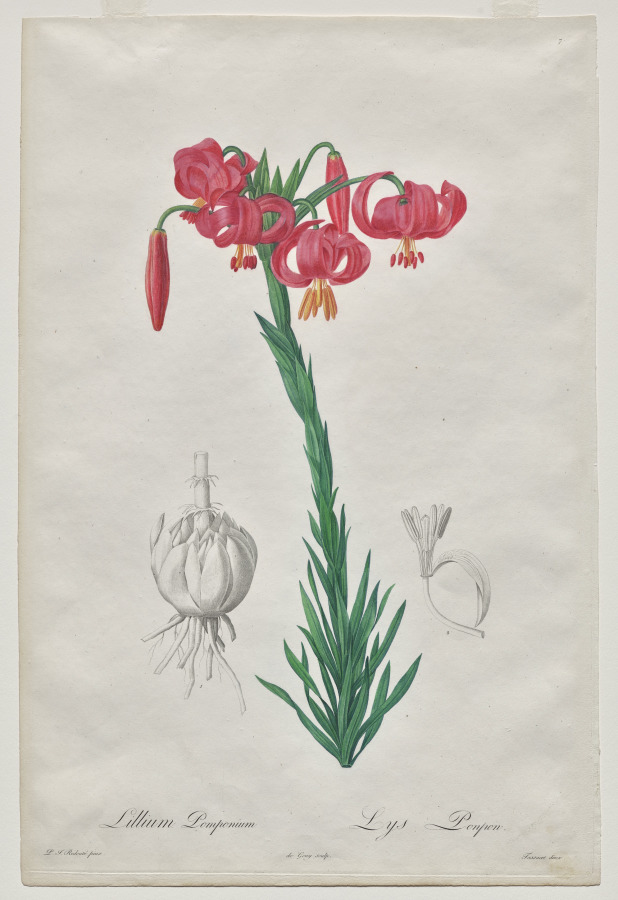
Vintage botanical illustrations: free plates for labels, packaging and posters
Two hundred years ago the best botanical artists drew roses and lilies leaf by leaf for kings and scientists. Today their plates are free, and they make the most beautiful labels.
Make it: Poster maker · Collage maker · Duotone generator · Templates
Five museums in one search box
Paletoo’s Art tab searches the Art Institute of Chicago, the Met, the Cleveland Museum of Art, SMK, the Wellcome Collection and Wikimedia Commons at once, keeps only what they mark public domain or CC0, and places the work with its credit. Free, in your browser.
Open in Paletoo