Art for designers · 4 min read · Save to Pinterest
Steal like an artist: eight design lessons from the great painters
Every one of these painters solved a problem designers still have: how to make one thing stand out, how to fill a square, how to make light glow. Here is what to take from each.
Eight lessons: crop boldly (Hokusai), frame your subject (Mucha), use gold as a material (Klimt), cut to a few shapes (Malevich), let colour carry the emotion (Kandinsky), build on a grid (Mondrian), make texture from dots (Seurat) and light one spot in the dark (Kuindzhi). All eight are in the public domain, so you can use the works themselves too.

- #836F37
- #8F7E46
- #979257
- #AFA682
- #C2A84D
How do I use a great painter’s idea in my own design?
Copy the rule, not the picture: a bold crop from Hokusai, a frame round the subject from Mucha, a few flat shapes from Malevich, a grid from Mondrian. All eight painters below are public domain, so you can also place the work itself: in Paletoo, Place an image › Art finds it by the painter’s name, and each lesson’s link opens the work with its colours as your palette.
Austin Kleon’s advice to “steal like an artist” means: take ideas, not pictures. With public-domain masters you can do both — learn the rule, and put the original work right into your layout.
Eight lessons, one painter each

01
Hokusai: crop the big thing, show the small thing
The subject of the Great Wave is Mount Fuji — tiny, in the middle. The wave in front of it does the work.
Take this: put something huge and close in the foreground and let your real message sit small behind it.
- #293A52
- #7D817C
- #C4B08F
- #D9C4A2
- #EBDFCC

02
Mucha: frame what matters
A halo behind the head, an arch around the figure, a panel for the name: Mucha never left an element floating.
Take this: give your product or face a shape behind it — a circle, an arch — and put the text in its own panel.
- #816035
- #C48B32
- #B08F5E
- #D2B78B
- #EDE9D6
03
Klimt: one precious material
Klimt laid real gold leaf on the canvas and kept the faces realistic. The contrast of flat gold and soft skin is the whole effect.
Take this: pick one special finish (gold, foil, a texture) and use it on one big shape, with a lot of plain around it.
- #836F37
- #8F7E46
- #979257
- #AFA682
- #C2A84D

04
Malevich: fewer shapes, more movement
Born in Kyiv, Malevich reduced painting to bars and squares that seem to fly. Tilt is what makes it move.
Take this: use three or four flat shapes, rotate them slightly, and set the headline on the same diagonal.
- #001356
- #0B7E3E
- #D88313
- #CFB6A3
- #E4E4E2

05
Kandinsky: let colour speak first
Kandinsky thought colours had sounds: yellow a trumpet, blue a cello. Composition VII has no subject and still shouts.
Take this: choose the palette by the feeling you want before you choose any picture or word.
- #905520
- #847252
- #9F9983
- #B8A349
- #BFC1AA

06
Mondrian: a grid you can see
Black lines, white planes, one big red square. The balance comes from unequal cells, not from symmetry.
Take this: draw your grid, then colour only one or two cells; make one cell much bigger than the rest.
- #151818
- #065C9B
- #D92519
- #D1B28C
- #E7E6E5

07
Seurat: texture from dots
Seurat placed pure colours side by side and let the eye mix them. Up close it is dots; from afar it glows.
Take this: add a halftone or dot texture to a flat colour or photo to make it feel printed and warm.
- #4A514E
- #5C5F5E
- #777372
- #999268
- #B2A899

08
Kuindzhi: one light in the dark
In 1880 people queued in the dark to see Arkhip Kuindzhi’s moonlit Dnipro; some looked behind the canvas for a lamp. It is all contrast.
Take this: make the whole design dark and give the brightest colour to one thing only — the product, the date, the button.
- #0B0B08
- #272C1B
- #3E4E2F
- #638652
- #8DB471
Put a lesson into practice
Its five colours — found live by Paletoo’s colour engine
- #293A52
- #7D817C
- #C4B08F
- #D9C4A2
- #EBDFCC
Click a colour to copy its code.
Opens a new post with the five colours as colour styles and the work placed from the museum, the Art tab open beside it.
Choose a master, take the palette and open it in Paletoo: the work arrives on the canvas and its colours in the colour styles. Now apply the lesson to your own content — or compare the movements they belong to in art movements for designers.
Ukrainian masters in the public domain
Kuindzhi (born in Mariupol), Malevich (born in Kyiv), Aivazovsky (Feodosia) and Kandinsky (who studied in Odesa) are all free to use. Their works make a striking series for Ukrainian brands: moonlit blue-green, suprematist red and black, the storm-green of the sea.

Find any master in Paletoo
- Open Paletoo — free in your browser, no sign-up — and start any document.
- Click Place an image in the toolbar and choose the Art tab (or press ⌘K / Ctrl K and type Search art…).
- Type an artist, a title or a subject; the chips narrow it to Painting, Prints, Botanical, Japan, Maps or Photos.
- Click a work to place it at the museum’s full size; its credit stays with the layer, ready for your caption.
Questions
What does “steal like an artist” mean?
It is the idea, popularised by Austin Kleon, that all creative work builds on what came before: study the people you admire, take their methods and remix them into something your own. It does not mean copying a work and calling it yours.
Which artists can I use freely in my designs?
Anyone who died in 1955 or earlier is in the public domain in the EU and Ukraine — Hokusai, Mucha, Klimt, Malevich, Kandinsky, Mondrian, Seurat, Van Gogh and Kuindzhi among them. Use museum files marked CC0 or public domain.
Can I put a painting by Klimt on a product?
Yes, Klimt died in 1918. Use a museum’s or Wikimedia Commons’ public-domain file. You cannot stop others from using the same painting, so add your own design around it.
Which Ukrainian artists are in the public domain?
Among many: Arkhip Kuindzhi, Ivan Aivazovsky, Kazimir Malevich, Heorhiy Narbut, Oleksandra Ekster, Mykola Pymonenko and Taras Shevchenko. Search their names in the Art tab.
The works on this page
Every picture is the museum’s own file, shown from its site at the size this page needs. The institutions mark each one public domain or CC0 on its record; this is how they ask to be credited.
- Gustav Klimt, The Kiss, 1907. Wikimedia Commons, public domain — www.wikidata.org
- Art Institute of Chicago, Clarence Buckingham Collection — www.artic.edu
- Art Institute of Chicago, Mrs. Victor F. Lawson Collection — www.artic.edu
- Kazimir Malevich, Suprematist Composition, 1916. Wikimedia Commons, public domain — www.wikidata.org
- Wassily Kandinsky, Composition VII, 1913. Wikimedia Commons, public domain — www.wikidata.org
- Piet Mondrian, Composition II in Red, Blue, and Yellow, 1930. Wikimedia Commons, public domain — www.wikidata.org
- Art Institute of Chicago, Helen Birch Bartlett Memorial Collection — www.artic.edu
- Arkhip Kuindzhi, Moonlit Night on the Dnieper, 1880. Wikimedia Commons, public domain — www.wikidata.org
- Ivan Aivazovsky, The Ninth Wave, 1850. Wikimedia Commons, public domain — www.wikidata.org
More art for designers

Art movements for graphic designers: seven styles, their palettes and a poster for each
Not a history lecture: what makes each style recognisable, the colours its real works use, the type that fits and a poster idea you can start in a minute.
Ukiyo-e for designers: what Hokusai and Hiroshige can teach a poster
Japanese woodblock prints were the posters and magazines of 19th-century Edo. Their rules — flat colour, a bold line, a daring crop — still make the strongest layouts.
Free art for commercial use: a million museum works, and how to use them safely
Great museums give away high-resolution files of works whose copyright has ended. Here is where they are, what the labels mean, and how to put one in your design in a minute.
Palette from a masterpiece: pick a painting, get its colours, use them
Old masters solved colour harmony long before colour wheels. Take their answer: five colours from one painting, tested on a poster, opened in your design.
Art Nouveau posters: Mucha’s grammar for today’s posters and labels
In 1895 an unknown Czech illustrator made a poster for Sarah Bernhardt and Paris queued to tear copies off the walls. His rules still sell perfume, beer and concerts.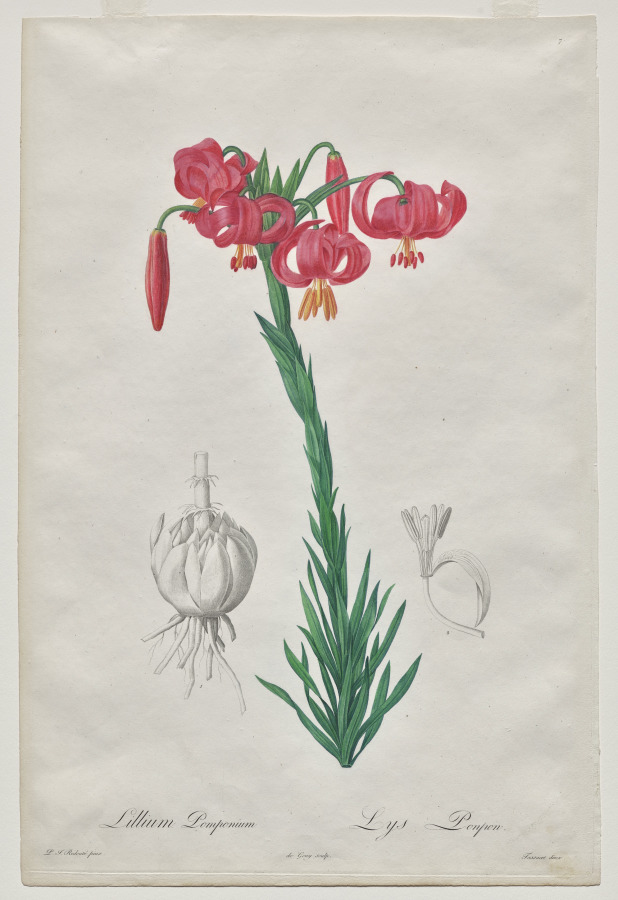
Vintage botanical illustrations: free plates for labels, packaging and posters
Two hundred years ago the best botanical artists drew roses and lilies leaf by leaf for kings and scientists. Today their plates are free, and they make the most beautiful labels.
Make it: Poster maker · Collage maker · Graphic design trends · Templates
Five museums in one search box
Paletoo’s Art tab searches the Art Institute of Chicago, the Met, the Cleveland Museum of Art, SMK, the Wellcome Collection and Wikimedia Commons at once, keeps only what they mark public domain or CC0, and places the work with its credit. Free, in your browser.
Open in Paletoo